.png)
 Tiếng Việt
 English


Global gold prices tumbled over 5% on October 22, falling to around $4,000 per ounce — the steepest drop in more than a decade. Yet, gold prices in Vietnam continued to soar. Experts explain why.

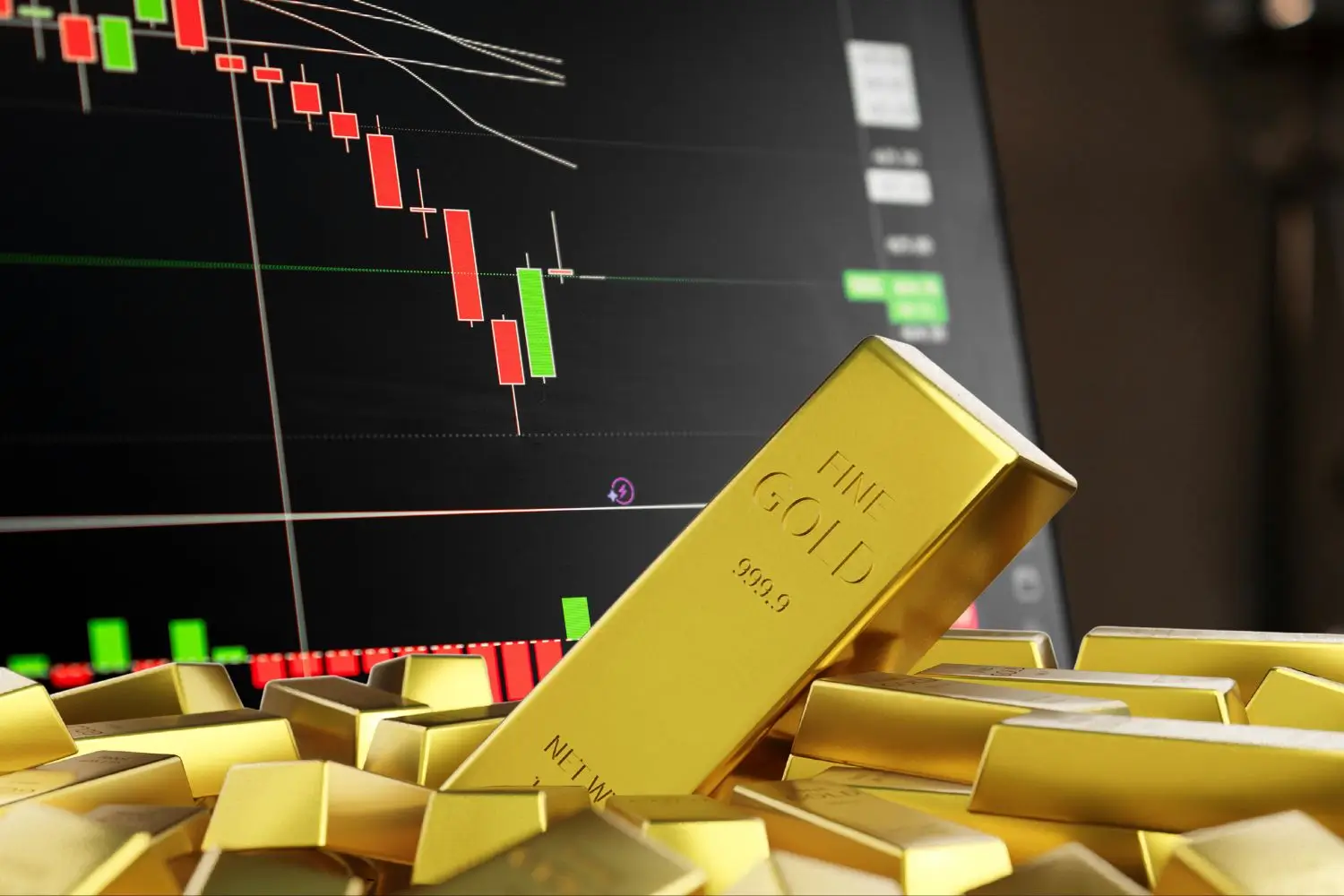
The global gold market faced a stunning correction on October 22, as spot gold prices in Asia fell sharply to around $4,048 per ounce, down more than $313 from the previous session.
Earlier in the U.S. session, gold settled near $4,120 per ounce, marking a 5.39% daily decline — its largest single-day drop since June 2013, according to FactSet data.
Kitco News reported that the market endured its most dramatic one-day fall in over a decade, mainly driven by a wave of profit-taking after gold had reached record highs. Meanwhile, renewed expectations that the U.S. Federal Reserve may delay interest rate cuts added downward pressure.
Seasoned traders weren’t surprised. Many had warned that gold’s parabolic rise this year — which pushed the metal to unprecedented highs above $4,000 per ounce — lacked a meaningful correction. As a result, when the reversal came, it was swift and severe, confirming long-standing technical concerns.
Recent U.S. economic data showed inflation cooling but not enough for the Federal Reserve to cut rates.
Higher-for-longer interest rates raise the opportunity cost of holding non-yielding assets like gold, prompting investors to shift toward higher-return assets such as bonds and equities.
Since October 2023, gold had surged by nearly $2,000 per ounce — almost doubling without a single double-digit correction. Analysts described this as an “unsustainable rally,” and the current sell-off represents a long-overdue cooldown following a year of relentless gains.
A strengthening U.S. dollar following upbeat U.S. economic data also contributed to the decline. Because gold is priced in dollars, a stronger dollar makes gold more expensive for foreign buyers, reducing global demand.
Still, analysts view the fall as a technical correction rather than the start of a prolonged bear market.
According to Carsten Menke, precious metals strategist at Lombard Odier (Switzerland):
“This correction was necessary after such a steep rally. The long-term fundamentals remain intact — central bank demand and geopolitical uncertainty continue to provide strong support for gold.”
Interestingly, while gold lost more than 5%, silver dropped by about 7.2%, lower than its typical historical correlation — where silver losses often double those of gold.
Analysts suggest this divergence indicates greater resilience in silver, largely thanks to its expanding industrial demand, particularly from solar energy and technology sectors.
If this pattern persists, silver could become the next focus for investors seeking a better risk-reward ratio compared to gold.
Contrary to the global downturn, domestic gold prices in Vietnam surged sharply on October 22, highlighting a notable “decoupling” between local and international markets.
DOJI Group (Hanoi & HCMC): VND 151.5 – 152.5 million/tael (buy–sell), up about VND 1 million per tael.
Bao Tin Minh Chau: VND 152 – 152.5 million/tael, up VND 1 million.
Phu Quy Group: VND 150.9 – 152.5 million/tael, up around VND 900,000 – 1,000,000.
Thang Long Dragon Rings (Bao Tin Minh Chau): VND 156.5 – 159.5 million/tael, up VND 1 million.
DOJI Hung Thinh Vuong 9999: VND 149.8 – 152.4 million/tael, up VND 800,000 – 900,000.
Bid–ask spreads remain wide, ranging from VND 1–3 million per tael, indicating robust local demand despite international volatility.
Three main factors explain this paradox:
Domestic Supply–Demand Imbalance
Vietnamese investors are turning to gold as a safe-haven asset amid economic uncertainty. With limited supply of SJC gold bars, domestic prices tend to remain elevated regardless of global movements.
Exchange Rate Impact (USD/VND)
A stronger U.S. dollar raises import costs, indirectly pushing up domestic gold prices even when global prices decline.
Safe-Haven Psychology
In times of turbulence, local investors often rush to gold as a store of value. This behavior makes the Vietnamese gold market react differently — sometimes even opposite — to international trends in the short term.
Most experts believe this is a temporary pullback, not the end of gold’s bull run.
After the sell-off subsides, gold could stabilize around the $4,000/oz mark and regain traction as global fundamentals remain supportive.
Key factors underpinning a potential recovery include:
Sustained central bank demand: 2025 is expected to mark the fourth consecutive year of central banks increasing gold reserves.
Geopolitical risks: Ongoing tensions between the U.S. and China, Middle East conflicts, and rising global debt levels continue to bolster gold’s safe-haven appeal.
Future monetary easing: Should the Fed begin lowering rates in 2026, gold would likely benefit from a weaker dollar and lower yields.
For Vietnamese investors, the message is clear: avoid chasing price surges. Instead, view the current correction as a window for strategic accumulation at more reasonable levels.
Monitor U.S. interest rates and dollar trends closely — they remain the strongest short-term drivers of gold prices.
Avoid emotional buying during price spikes. Patience often yields better entry points.
Diversify portfolios: Gold should make up only 15–20% of total assets to balance risk.
Physical buyers: Pay attention to the buy–sell spread and storage costs, especially when prices are volatile.
October 22 marked a historic session for the global gold market: a 5% plunge in one day, the steepest fall in over a decade. Yet, paradoxically, Vietnam’s gold market surged.
While the two markets seem to move in opposite directions, both reveal a deeper truth — investors worldwide are still seeking safety amid uncertainty.
In the short term, volatility will persist. But in the long term, gold remains a trusted hedge against inflation, instability, and currency risk.
The key is to stay rational, not reactive, and approach gold investing as part of a balanced, long-term strategy — not a race to chase quick profits.
1. Why did global gold prices drop over 5% on October 22?
Due to widespread profit-taking after record highs and concerns that the Fed might maintain higher interest rates for longer.
2. Why are Vietnam’s gold prices rising while global prices fall?
Local dynamics — including limited supply, exchange rate movements, and strong safe-haven demand — keep domestic prices elevated.
3. Will gold prices recover soon?
Most likely yes. Strong central bank buying and geopolitical risks remain supportive of gold in the medium to long term.
4. Should investors buy gold now?
Only after the market stabilizes. Focus on long-term accumulation rather than short-term speculation.